Latgale was one of the biggest positive surprises of our recent travels. We went to eastern Latvia in our motorhome, with three children and a dog, in September, after the main tourist season had already ended. And we found exactly what we love most about travelling: plenty of nature, lakes, forests, the winding Daugava River, small towns and, above all, peace and quiet. Sometimes absolute silence.
If you like eastern Poland, Sweden or the quieter parts of Norway, you will probably feel at home in Latgale too. During this trip, Latvia reminded us of Scandinavia many times – not only because of the nature and low population density, but also because of the approach to relaxation. Saunas, hot tubs and swimming in lakes are not just attractions added for tourists. They are simply part of the local way of relaxing.
We spent four days in Latgale. That was enough to see several of the most important places, but we very quickly came to the conclusion that you could easily spend a whole week here without getting bored.
Our trip to Latgale was organised in cooperation with LIAA and the local tourism organisation Latgale Travel. All impressions and opinions described in this article are our own.
Table of contents
Latgale – where is it and why is it worth visiting?
Latgale is the eastern part of Latvia, stretching towards the borders with Lithuania, Belarus and Russia. On the map it does not look like an enormous region, but travelling through it feels completely different from quickly moving between large European cities.
Here, the road itself is part of the attraction. Forests, fields, lakes, wooden houses, small villages and long stretches where you may see more animals than cars.
Latgale also has a very interesting history and many Polish connections. Polish influences can be found, among other places, in the history of the Plater family in Krāslava and the Kierbedź family associated with Lūznava Manor.
For us, however, the biggest attraction of Latgale was definitely its nature. This is one of those regions where, between visiting a museum, palace or castle, it is worth simply stopping the car, climbing a viewing tower or sitting by a lake for a while.
Our route through Latgale
Day 1
Daugavpils – Daugavpils Fortress – Engineering Arsenal – bends of the Daugava River – Camping Daugavas lokos
Day 2
Starp debesīm un zemi – Krāslava – Plater Palace complex – Klajumi
Day 3
Aglona – Lūznava – Ludza – Dzerkaļi
Day 4
Rēzekne and the drive back towards Poland
Do not treat this route as a plan that has to be followed point by point. Quite the opposite. Latgale is a great region for slower travel and it is definitely worth leaving some time for spontaneous stops along the way.
Daugavpils – fortress, vintage cars and the bends of the Daugava River
We began exploring Latgale in Daugavpils. It is the second largest city in Latvia, but do not expect the atmosphere of a crowded metropolis.
Our first stop was Daugavpils Fortress. It is an enormous fortification complex whose present form dates back to the 19th century. The site is really extensive, so simply walking between the buildings, gates and fortifications can take quite a while. [source]
We spent about an hour walking around and, when travelling with children, that felt just right. Dogs can also walk freely around the fortress grounds, and we had no problem finding a place nearby for our large motorhome.
Engineering Arsenal – a museum our children enjoyed too
Inside the fortress you will find the Engineering Arsenal Centre of Technology and Industrial Design. If you like vintage cars, motorcycles or technology in general, it is definitely worth going inside.
The large halls contain vehicles from the Soviet era as well as Western cars and motorcycles. The whole exhibition is arranged in a much more modern way than a traditional motoring museum where cars simply stand next to one another. [source]
A big plus is how family-friendly the museum is. Our children spent part of the visit exploring the exhibition with us and later moved to the space prepared for younger visitors downstairs. As a result, everyone left the museum happy :)
If you are travelling with a dog, it is worth checking the current entry rules in advance. During our visit, dogs were only allowed inside if they could be carried, so that obviously was not an option with Molly.
You can also eat inside the fortress. We stopped at Café Arsenāls and the food was very good. In fact, during this trip we started paying more attention to restaurant prices – on many occasions we ate really well for less than we would have expected to pay in Poland.
If you have more time in Daugavpils
Within the fortress itself you will also find the Rothko Museum, dedicated to Mark Rothko, who was born in Daugavpils. If contemporary art interests you, you can easily spend several more hours here. In the city centre, it is also worth seeing the historic architecture and Church Hill, where places of worship belonging to several different denominations stand close to one another.
Daugavas Loki Nature Park and views over the Daugava River
From Daugavpils we continued towards Krāslava. And this is where the Latvia that impressed us the most really begins.
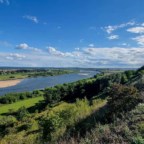
Daugavas Loki Nature Park protects the valley of the Daugava River and its characteristic bends. One of the easiest ways to see them from above is to climb the Vasargelišķi viewing tower. It is literally only a short walk from the car park, and from the top you can see the Daugava winding between the forests. [source]
Places like this are the essence of Latgale for us. You do not need spectacular infrastructure or a theme park. There is a river, a forest, a viewing tower and hardly anyone around.
Camping Daugavas lokos
We spent our first night at Camping Daugavas lokos, right on the banks of the Daugava River.
We can definitely recommend this place to people who are not travelling by motorhome as well. There are cottages and glamping options, and the entire property is set in a truly beautiful location by the river.
With our motorhome we could connect to electricity, and water and campsite facilities are also available. There is a playground, water activities, a sauna and a hot tub overlooking the river.
And the greatest luxury? Silence.
We arrived after the main season and the campsite was almost completely empty. In the evening there were no cars, no music and no people to be heard. Just nature.
During our visit, the property was already preparing to close for the season, so if you are planning a trip in late autumn, make sure to check the current opening dates in advance.
From the campsite we also went on a short cruise along the Daugava River. If the weather allows, it is a great complement to seeing the river bends from above earlier in the day.
Starp debesīm un zemi – a family park “Between Heaven and Earth”
The next day we started at a place created mainly with families and children in mind – Sporta atrakciju parks “Starp debesīm un zemi”, which can be loosely translated as the “Between Heaven and Earth” sports and recreation park.
We spent several hours here and our children definitely did not want to leave quickly.
There is a rope park, very enjoyable footgolf, plenty of space to run and play, and a small lake. Additional water attractions are available in summer. You can also stay overnight, use the sauna or simply come here for something to eat. [source]
The atmosphere reminded us a little of Clement’s Orchards in Poland – not because the attractions are identical, but because both are relaxed, family-friendly outdoor spaces where children can easily spend several hours having fun.
If you are travelling without children, we would not consider this an essential stop on the route. For families, however, it is definitely worth considering.
Krāslava – the Plater Palace, crafts and a quiet town on the Daugava River
Our next stop was Krāslava.
It is a small town that can easily be explored in a few hours, and its most important attraction is the Plater family palace complex. The palace is surrounded by a large park, and the history of the Polish-Lithuanian Plater family is one of the most interesting Polish connections you encounter while travelling through Latgale. [source]
We visited several exhibitions in the complex, including a doll exhibition, but we particularly enjoyed the nearby Krāslava Crafts Centre. Several different craft workshops operate here, and visitors can not only see local handicrafts but also take part in workshops themselves. We joined a family woodworking workshop. [source]
If you have a little more time in Krāslava, it is also worth visiting the Priedaine viewing tower, which offers views over the Daugava valley and the town, as well as St Louis Church. Krāslava is also a good base for further exploration of Daugavas Loki Nature Park.
Klajumi – one of those places we did not want to leave
In the afternoon we headed to a place that was initially supposed to be simply another stop and an overnight stay on our route.
It turned out that Klajumi became one of our favourite places during the entire trip through Latgale.
It is a family-run farm and horse stable surrounded by forests, fields and meadows within Daugavas Loki Nature Park.
This is not a riding stable where you simply make two circles around a fenced paddock. You can head out into the surrounding countryside on horseback, children can ride calm horses led individually by the staff, and if you do not want to ride in the saddle, horse-drawn carriage rides are also available.
Our children loved it, and so did we.
Even if horses do not interest you at all, it is still worth considering a visit simply for the location and the food.
At Klajumu Ķēķis we had dinner, breakfast and other meals based on local cuisine. Everything was homemade, hearty and genuinely delicious. This is one of those places where, after two meals, you start wondering whether you really need to leave the next day :)
There are also cottages, apartments and traditional saunas on site. We slept in our motorhome next to the farm, but if we returned without it, we would happily choose one of the accommodation options here.
Aglona – Latvia’s most important Catholic sanctuary
The following day we headed towards Aglona.
This is where you will find the Basilica of the Assumption of the Blessed Virgin Mary, Latvia’s most important Catholic sanctuary. The present late-Baroque church was built in the 18th century and is distinguished by its two tall towers, which can be seen from a distance. [source]
Thousands of pilgrims come here on 15 August, while outside the largest religious celebrations the area is very peaceful. Pope John Paul II also visited Aglona in 1993.
Even if you do not visit places for religious reasons, it is worth stopping here. The basilica and its surroundings are impressive, and the stop fits very naturally into a route between Krāslava and Rēzekne.
Lūznava Manor – history, a park and a surprisingly good attraction for children
From Aglona we continued to Lūznava Manor.
And once again Latgale surprised us. The restored building and surrounding park are worth seeing in themselves, but inside we also found a very well-prepared interactive exhibition dedicated to Stanisław Kierbedź.
Kierbedź was one of the most important 19th-century engineers associated with bridge and railway construction, and his family was connected with the Lūznava estate. The exhibition, however, is not a traditional series of display cases. Children can learn about bridges, structures and railways through interactive elements, so instead of waiting for the adults to finish looking at the exhibition, they had plenty to do themselves. [source]
Next to the manor there is also a small free area with nets and obstacles suspended between the trees. Officially, you could call it a small rope park, although it feels more like a forest playground above the ground. After visiting the interior, it was the perfect stop for the children.
Ludza – castle ruins, lakes and sunset
Ludza is a small town, and that is exactly why we liked it so much.
Its most important attraction is the ruins of the medieval castle, located on a hill between the lakes. The first stone castle was built here towards the end of the 14th century, and today mainly fragments of its walls remain. [source]
You do not come here for a huge castle full of chambers. You come here for the setting.
From the hill there is a beautiful view over the town and lakes, and it is especially pleasant around sunset. After coming down, you can walk along the waterfront promenade and cross the floating bridge.
We had no problem finding a place nearby for our motorhome, but the centre is small enough that it is best to leave your vehicle and continue on foot.
If you have more time, also visit the Great Synagogue in Ludza. It is one of the most interesting reminders of the town’s former Jewish community and today houses a small museum exhibition. It is also worth simply walking around the old centre – narrow streets, wooden houses and the lakes create a very peaceful atmosphere. [source]
Local flavours at Ludza Craftsman Centre
In the evening we also visited Ludza Craftsman Centre, where we learned about local culinary traditions.
Among other things, we made asuškas ourselves – traditional sweet treats from Latgale. Workshops like this are a great addition to sightseeing, especially with children. Instead of another exhibition, you can make something yourself and, of course, eat the results afterwards.
Dzerkaļi Recreation Complex
We stayed a few kilometres outside Ludza at Dzerkaļi Recreation Complex, located on the shores of Lake Cirma.
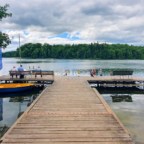
Once again: lots of space, silence and water. There are cottages, a beach, a playground, spaces for tents and motorhomes, and enough facilities to make a longer stay comfortable.
During the season, Dzerkaļi can easily be treated not only as a place to spend one night but also as a base for several days of relaxing by the water.
Rēzekne – a family-friendly city in the heart of Latgale
Our final larger stop was Rēzekne.
Here we had a slightly different impression than in the other places. Looking at the city from the perspective of our family, we thought it simply seemed like a very pleasant place to live with children.
A good place to start exploring is the Zeimuļs Centre of Creative Services at Krasta iela 31. The building itself is unusual and definitely catches the eye, with sloping forms and green roofs. Inside, a huge number of activities and workshops are organised for local children and young people. [source]
For tourists, the important thing is that the tourist information centre is located in the same building. You can pick up maps, find out what is currently happening in the city, use the toilet and children’s corner, and plan the rest of your sightseeing. There is also a viewpoint from which you can look towards the nearby castle hill.
And all of this is right next to a large car park and only a few minutes’ walk from the city centre.
Rēzekne Castle ruins
Right next to Zeimuļs are the ruins of the medieval castle in Rēzekne. It only takes a few minutes to climb the hill, and from the top you get a good view over the city centre. Not much of the walls remains today, but the combination of the castle hill, the modern architecture of Zeimuļs and the city centre creates a very interesting space. [source]
With the children we also visited the indoor KidZone play area. We would not treat it as an attraction worth travelling to Rēzekne specifically for, but it illustrates something we noticed throughout the entire trip – families with children are very well catered for here.
What else is worth seeing in Rēzekne?
If you have more time, it is worth visiting the Green Synagogue, one of the most important monuments of the city’s Jewish heritage, and seeing Latgale Embassy GORS, a modern cultural centre and concert hall. Rēzekne is also a good base for trips towards Rāzna National Park and Lake Rāzna.
Latgale with children – is it worth visiting?
Definitely.
Importantly, not because every town has huge amusement parks. Quite the opposite. What we liked most was that family-friendly attractions are naturally incorporated into ordinary sightseeing.
Engineering Arsenal has a space for children. At Lūznava, instead of a traditional exhibition, there is an interactive display about building bridges. Next to the manor there is a forest area with obstacles. In the towns we found playgrounds, while between them there are lakes, horses, parks, viewpoints and plenty of space to run around.
On top of that, practically everywhere we went we felt genuinely welcome with children.
And that is probably the biggest advantage of travelling through Latgale as a family. You do not have to constantly search for “attractions for children”. They simply travel with you and you discover the region together.
Latgale by motorhome
We travelled this entire route in our own motorhome and Latgale turned out to be very convenient in this respect.
Outside the centres of the larger towns, we had very few problems with parking. Even at tourist attractions there is usually plenty of space, and road traffic is light.
We stayed overnight at Camping Daugavas lokos, Klajumi and Dzerkaļi. At the first and last places we used motorhome facilities and an electrical hook-up. At Klajumi we simply parked in a prepared area next to the farm.
All three places also accepted our dog.
We would not, however, consider Latgale a destination only for motorhome travellers. Cottages, guesthouses and small hotels are scattered throughout the region, and staying in places such as Klajumi or beside one of the lakes allows you to experience the local atmosphere much better than simply driving through the region in a single day.
Accommodation in Latgale – where to stay?
We travelled our entire route through Latgale in a motorhome. We stayed at Camping Daugavas lokos, Klajumi and Dzerkaļi, so we know these three places personally, although we used them as motorhome travellers rather than staying in their rooms or cottages. Below we have also included several hotels worth checking if you are travelling by car.
Before booking, check the current price, cancellation conditions, parking and whether the selected room or cottage will accommodate your entire family:
HomeLike Hotel – Daugavpils Address: Mihoelsa iela 66, Daugavpils Why consider it: a very good location in central Daugavpils, particularly useful if you want to explore the city on foot in the evening. Larger rooms are also available, so it is worth checking when travelling as a family. Link:check current prices on Booking.com.
Park Hotel Latgola – Daugavpils Address: Ģimnāzijas iela 46, Daugavpils Why consider it: a large hotel right in the city centre, useful as a base for exploring Daugavpils and for trips towards Daugavas Loki Nature Park. Link:check current prices on Booking.com.
Camping Daugavas lokos Address: “Erlavas”, Slutišķu sādža, Augšdaugavas novads Why consider it: we stayed here during our motorhome trip and can definitely recommend the place. It has a beautiful location directly beside the Daugava River, plenty of peace and space, cottages, a playground, sauna and hot tub. It is also a great base for exploring Daugavas Loki Nature Park. Link:check current prices on Booking.com.
Klajumi Countryside Cottages & Nature Retreat – near Krāslava Address: Klajumi, Kaplavas pagasts, Krāslavas novads Why consider it: one of our favourite places during the entire trip. Horses, local food, nature, saunas and absolute peace and quiet. We stayed next to the farm in our motorhome, but cottages and apartments are also available, including options suitable for families. Link:check current prices on Booking.com.
Dzerkaļi Recreation Complex – near Ludza Address: Dzerkaļi, Cirmas pagasts, Ludzas novads Why consider it: another waterside place we can recommend from personal experience. We stayed here in our motorhome, but wooden cottages are also available. The complex is located directly beside Lake Cirma and has a beach, playground and plenty of open space. It is a very peaceful place both for a single night and for several days of relaxation. Link:check current prices on Booking.com.
Lucia with Self Check-in – Ludza Address: Kr. Barona iela 20-1, Ludza Why consider it: a location practically next to the old town, lakes and castle ruins. A good option if you want to leave the car in the evening and explore Ludza on foot. Link:check current prices on Booking.com.
Kolonna Hotel Rēzekne – Rēzekne Address: Brīvības iela 2, Rēzekne Why consider it: a central location by the river and a convenient base both for exploring Rēzekne and for further trips around the northern part of Latgale. Link:check current prices on Booking.com.
Latgale in autumn – is September a good time to visit?
We visited Latgale in mid-September and the timing worked very well for us.
The main season had already ended, children in Latvia were back at school, and we had most of the places we visited almost entirely to ourselves. At the same time, the weather was still good enough for normal sightseeing, horse riding, walking and spending evenings outdoors.
You only need to remember that some seasonal attractions and campsites gradually reduce their operations in autumn. If you are planning a trip at the end of September or in October, it is particularly important to check current opening hours and accommodation availability in advance.
On the other hand, if you are looking for silence, empty viewpoints and a peaceful side of Latvia, early autumn may actually be better than the middle of summer.
Is Latgale worth visiting?
After these few days, the answer for us is very simple: yes.
What we perhaps appreciate most is that Latgale does not try to become another loud tourist region packed with attractions created solely to draw in visitors.
Nature is still the biggest attraction here.
The Daugava River winding between forests. Lakes. Horses. Small towns. Wooden houses. Castle ruins. Saunas. Local food. Empty roads and an enormous sense of space.
On top of that, there are places genuinely well prepared for families with children and very welcoming people.
We already liked Latvia before this trip, but after travelling through Latgale we know one thing for sure – we definitely want to come back. And next time, we would happily stay in Latgale a little longer.
...prefers a quiet, lazy vacation, but does not miss the opportunity to see something interesting and bravely keeps pace with Kamila. Contrary to appearances, he also loves active leisure :) He is responsible for the organizational and practical part of the trip, i.e. he makes sure that we get to the ... More about us >>







 Austria
 Azores
 Canary Islands
 China
 Cuba
 Cyprus
 Czech Republic
 Denmark
 Dominican Republic
 Dubai
 Faroe Islands
 Germany
 Hungary
 Iceland
 Italy
 Japan
 Lithuania
 Madeira
 Malta
 Mexico
 Morocco
 Poland
 Portugal
 Singapore
 Slovakia
 Spain
 Switzerland
 Ukraine
 United Kingdom
 United States


